# Datadog vs New Relic (2026): Features, Pricing & a Cost-Efficient Alternative
> A buyer's guide to Datadog vs New Relic: how each vendor bills, contract terms, monthly and annual cost for a 50-host team, APM, logs, NRQL, OpenTelemetry, AI, and when to choose each, with sourced list prices.
Source: https://openobserve.ai/blog/datadog-vs-new-relic/
Published: 2026-11-26
Authors: Md Mosaraf
Category: Engineering
Tags: OpenObserve, Comparisons, Observability, Monitoring, Cost, Tracing
---
## What You'll Learn
- Compare Datadog and New Relic pricing models with sourced list prices
- Understand the differences in APM, logs, infrastructure, query languages, and AI
- Estimate a monthly and annual bill for a 50-host, 10-engineer team on each platform
- **Compare contract terms**: annual, month-to-month, and pay as you go
- Know which factors make your real bill differ from list-price estimates
- See when an open-source, ingest-priced platform is a better fit
**Datadog vs New Relic** comes down to how each one bills: Datadog charges per host and per product, so costs grow with infrastructure, while New Relic charges per GB of data and per user, so costs grow with data volume and team size. Both cover APM, infrastructure, logs, browser monitoring, and synthetics. This guide is written for the engineering leaders and buyers choosing between them: how each one bills, what a 50-host team pays per month and per year, which features differ, and what to check before you sign.
## TL;DR
- Datadog prices infrastructure and APM per host, at $15 and $31 per host per month on annual billing, with logs, RUM, and custom metrics billed as separate products.
- New Relic has no per-host fees and instead charges $0.40 per GB of data beyond a free 100 GB a month, plus $49 per core user and up to $349 per full platform user each month.
- Datadog's bill grows with your fleet, and New Relic's bill grows with your team, so the lower-cost option depends on your host-to-engineer ratio, and real bills also vary with discounts, data volume, and products used.
- Both are SaaS-only platforms with their own query languages, which adds lock-in whichever you choose.
- OpenObserve is the cost-efficient alternative to both, with ingest-based pricing, no per-host or per-user fees, SQL and PromQL, and native OpenTelemetry ingestion on [OpenObserve Cloud](https://cloud.openobserve.ai) or self-hosted.
## Datadog vs New Relic at a glance
Datadog and New Relic look similar on a feature checklist, so the differences that matter are in pricing units, data model, and how you query. The table summarizes both on the points buyers ask about most.
| | Datadog | New Relic |
| --- | --- | --- |
| **Deployment** | SaaS | SaaS |
| **Pricing model** | Per host per product, plus per unit of data | Per GB ingested plus per user |
| **Infrastructure monitoring** | $15 per host per month (Pro), $23 (Enterprise), annual | Included, no per-host fee |
| **APM** | $31 per APM host per month, annual | Included, no per-host fee |
| **Logs** | $0.10 per GB ingested plus $1.70 per million events indexed (15-day) | Counted as data: $0.40 per GB (Original Data) or $0.60 (Data Plus) beyond 100 GB free |
| **Users** | No per-user fee | Basic free; core $49 per month; full platform $99 (Standard) or $349 (Pro, annual) |
| **Free tier** | Up to 5 hosts, 1-day metric retention | 100 GB of data a month, 1 full platform user, unlimited basic users |
| **Query language** | Datadog query syntax | NRQL |
| **AI** | Watchdog and Bits AI | New Relic AI |
Sources: Datadog pricing page, November 2026; New Relic pricing page, November 2026.
## What is Datadog?
Datadog is a SaaS observability and security platform. You install the Datadog Agent on hosts and add tracing libraries to applications, and Datadog's integrations collect data from cloud services, databases, and tools. Each capability, such as Infrastructure Monitoring, APM, Log Management, RUM, Synthetic Monitoring, and Cloud SIEM, is a separately priced product with its own billing unit.
That product-by-product model lets teams buy only what they use, but it also means the bill has many meters: hosts, APM hosts, ingested GB, indexed log events, indexed spans, custom metrics, and sessions. Our [Datadog pricing guide](/blog/datadog-pricing/) breaks down each one.
## What is New Relic?
New Relic is a SaaS observability platform that stores every kind of telemetry (metrics, events, logs, and traces) in one database and queries it with NRQL, the New Relic Query Language. Its language agents and infrastructure agent collect data, and it also accepts OpenTelemetry data.
New Relic sells the platform as one product rather than many. Instead of per-host fees, you pay for data ingested beyond a free monthly allowance and for the users who need full access. Hosts, agents, and containers are included at no extra cost (Source: New Relic pricing page, November 2026).
## Which is better, Datadog or New Relic?
Neither is better for every team. The right choice follows your cost drivers (hosts or headcount) and how your engineers work:
| If your priority is... | Datadog | New Relic |
| --- | --- | --- |
| Many engineers with full access | No per-user fee | $49 to $349 per user per month |
| Many hosts, containers, or heavy autoscaling | Per-host fees grow with the fleet | Hosts included at no extra cost |
| Widest catalog of turnkey integrations | Stronger | Good |
| One query language for every data type | Separate syntax per product | NRQL everywhere |
| Buying month to month with no commitment | Month-to-month at a premium | Pay as you go on Standard and Pro |
| Self-hosted deployment | Not offered | Not offered |
If both host fees and seat fees are a problem, or you need to self-host, an open-source, ingest-priced platform such as OpenObserve is worth evaluating alongside them.
## Datadog vs New Relic pricing: per host vs per user
The pricing model matters more than any single list price, because it decides what makes the bill grow: hosts, data, or people.
### How Datadog pricing works
Datadog meters infrastructure, not people. Infrastructure Pro is $15 per host per month and APM is $31 per APM host per month on annual billing, and logs add $0.10 per GB ingested plus $1.70 per million events indexed with 15-day retention (Source: Datadog pricing page, November 2026). Adding a node raises the bill; adding an engineer doesn't.
### How New Relic pricing works
New Relic meters data and people. The free tier includes 100 GB of data a month; beyond that, Original Data costs $0.40 per GB and Data Plus $0.60 per GB. Basic users are free, core users are $49 per month, and full platform users are $10 for the first and $99 for each additional user on Standard (up to 5), or $349 per user per month on Pro with an annual commitment (Source: New Relic pricing page, November 2026).
Figure: The billing units on each platform. More meters means more ways for the bill to grow. Sources: Datadog and New Relic pricing pages, November 2026.
In practice, Datadog favors teams with a small fleet and many engineers, and New Relic favors teams with a large fleet and few engineers who need full access. The chart below shows how New Relic's user fees grow with team size on the Pro edition.
### Datadog vs New Relic contract terms: annual vs pay as you go
Datadog publishes annual, month-to-month, and on-demand prices, and annual billing is the lowest: Infrastructure Pro is $15 per host per month annually versus $18 month-to-month, APM is $31 versus $36, and 30-day indexed logs are $2.50 versus $3 per million events (Source: Datadog pricing page, November 2026).
New Relic Standard and Pro can be paid as you go, billed monthly with no commitment beyond the current month. Pro full platform users cost $349 per month on an annual commitment or $418.80 pay as you go. Pro and Enterprise customers can also buy a savings plan: an annual or multi-year pool of funds that covers any mix of usage, with unused funds rolling over for up to 12 months (Source: New Relic pricing page, November 2026).
### Does New Relic cost less than Datadog?
It depends on your ratio of hosts to engineers. Each Datadog host with infrastructure monitoring and APM costs $46 a month on annual billing, while each New Relic Pro full platform user costs $349 a month. Roughly, every 7 or 8 Datadog hosts cost about the same as one New Relic Pro full user, before data charges. A team with 100 hosts and 5 full users usually pays less on New Relic; a team with 20 hosts and 30 full users usually pays less on Datadog. Data volume then shifts the balance: Datadog's log indexing and New Relic's $0.40 per GB both grow with every GB you keep searchable.
## Datadog vs New Relic: features compared
Both platforms cover the same core areas, so the differences are in how each capability is delivered, queried, and billed.
### Datadog vs New Relic APM and distributed tracing
Both platforms provide distributed tracing, service maps, error tracking, and code-level visibility for common languages, and both accept traces over OpenTelemetry (OTLP). The difference is again in billing. Datadog charges $31 per APM host per month, with each APM host including 150 GB of ingested spans and 1 million indexed spans; extra spans cost $0.10 per GB to ingest and $1.70 per million to index with 15-day retention (Source: Datadog pricing page and APM billing docs, November 2026).
New Relic has no APM host fee. Trace data counts toward the same per-GB data allowance as logs and metrics, so APM cost depends on how much trace data you send, not on how many hosts run traced services. For a side-by-side look at how trace storage works on another platform, see [Datadog vs OpenObserve for traces and APM](/blog/datadog-vs-openobserve-part-3-traces-apm/), and for a wider list of options, our [top APM tools](/blog/top-10-apm-tools/) roundup.
### Datadog vs New Relic log management
Datadog separates log ingestion from indexing. Ingesting costs $0.10 per GB, and making logs searchable costs $1.70 per million events with 15-day retention or $2.50 with 30-day retention on annual billing (Source: Datadog pricing page, November 2026). At about a million events per GB, indexing costs 17 to 25 times as much as ingestion, which is why most Datadog log optimization is about indexing less; see our [Datadog cost optimization guide](/blog/datadog-cost-optimization/).
New Relic doesn't separate ingestion from indexing: logs are data, billed at $0.40 per GB (Original Data) or $0.60 per GB (Data Plus, which adds up to 90 days of extra retention for most data types) beyond the free 100 GB (Source: New Relic pricing page, November 2026). Every log you send is queryable with NRQL, but every log also counts toward the per-GB bill, so filtering noise before ingestion still matters.
### Datadog vs New Relic infrastructure and Kubernetes monitoring
Datadog runs the Datadog Agent on each host, or as a DaemonSet with a Cluster Agent on Kubernetes, and bills each node as a host. Pro includes 5 containers per host and Enterprise 10; extra containers are billed per container hour (Source: Datadog Container Billing docs, November 2026). Autoscaling clusters therefore raise the infrastructure bill as they grow.
New Relic deploys its infrastructure agent and Kubernetes integration in the same way, but hosts and containers are included at no extra cost, so node count doesn't change the price. The data those agents send still counts toward the per-GB bill. For vendor-neutral cluster monitoring, see [Kubernetes monitoring with OpenTelemetry and Prometheus](/blog/kubernetes-monitoring-with-opentelemetry-prometheus/).
### NRQL vs Datadog query syntax: which query language is easier?
NRQL is a SQL-like language: `SELECT count(*) FROM Transaction WHERE appName = 'checkout' FACET httpResponseCode SINCE 1 hour ago` reads naturally to anyone who knows SQL, and it queries every data type in one place. Datadog uses separate syntaxes for each product, such as tag-based metric queries, a search syntax for logs, and facets for traces.
Both are vendor-specific. NRQL is close to SQL but not the same, and Datadog queries don't transfer to other tools, so dashboards and alerts become migration work if you ever switch. Standard SQL for logs and traces and PromQL for metrics keep those skills portable.
### Datadog vs New Relic OpenTelemetry support
Both vendors accept OpenTelemetry traces, metrics, and logs over OTLP, so you can instrument with the OpenTelemetry SDKs and the Collector and send to either. In practice, each vendor's richest features still assume its own agents: Datadog's integrations and the Datadog Agent, and New Relic's language agents. Standardizing on OpenTelemetry keeps your instrumentation portable, which is the main protection against lock-in with either vendor. Our [OpenTelemetry Collector configuration guide](/blog/opentelemetry-collector-configuration-guide/) shows how to export to more than one backend.
### Datadog vs New Relic AI features
Datadog's Watchdog detects anomalies and surfaces likely causes automatically, and Bits AI is its assistant for investigations. New Relic AI is an assistant that answers questions in natural language, translates them into NRQL, and helps explain errors and alerts. In our view, both AI layers are most useful on data inside each vendor's own platform, which adds to the cost of switching later. Both are priced within each vendor's model rather than as a standalone product.
### Datadog vs New Relic feature comparison table
| Capability | Datadog | New Relic |
| --- | --- | --- |
| Infrastructure and Kubernetes monitoring | Yes, per host | Yes, no per-host fee |
| APM and distributed tracing | Yes, per APM host | Yes, data-based |
| Log management | Yes, ingest plus index | Yes, data-based |
| Browser monitoring and session replay | RUM and Session Replay | Browser monitoring and session replay |
| Synthetic monitoring | Yes | Yes, 500 checks free, then $0.005 per check |
| Query language | Datadog query syntax | NRQL |
| OpenTelemetry ingest | OTLP | OTLP |
| AI assistant | Bits AI, Watchdog | New Relic AI |
| Self-hosted option | No | No |
Sources: Datadog pricing page and docs, November 2026; New Relic pricing page, November 2026.
## How much do Datadog and New Relic cost for a 50-host team?
List prices are easier to compare with a worked example. Take a team with 50 hosts running infrastructure monitoring and APM, 100 GB of logs a day (about 3,000 GB a month) that should stay searchable for 30 days, and 10 engineers who need full access to investigate incidents.
| Monthly line item | Datadog (annual list prices) | New Relic Pro (annual list prices) |
| --- | --- | --- |
| Hosts (50) | $750 infrastructure + $1,550 APM | $0, no per-host fee |
| Logs: 3,000 GB, searchable | $300 ingest + $7,500 indexing (30-day) | 2,900 GB beyond the free 100 GB × $0.40 = $1,160 |
| Users: 10 full access | $0 | 10 × $349 = $3,490 |
| **Subtotal, before trace and metric data** | **$10,100** | **$4,650** |
On New Relic, trace and metric data from the APM and infrastructure agents also counts toward the per-GB bill, so add that volume at $0.40 per GB. On Datadog, the APM host fee includes 150 GB of ingested spans per host. On OpenObserve Cloud, the same 3,000 GB of logs costs $1,500 a month on an annual contract ($2,100 pay as you go) with 30 days of searchable retention included, $0.01 per GB queried, no host fees, and no user fees; traces and metrics are billed at the same per-GB rate.
Your numbers will differ with your mix of hosts, data, and users. If you're on Datadog today, upload your invoice to the [OpenObserve Bill Analyzer](/datadog-pricing-comparison/) for a line-by-line comparison.
### Annual cost of Datadog vs New Relic for a 50-host team
Budgets are approved per year, so here is the same team over 12 months, before trace and metric data:
| Annual cost | Annual contract prices | Month-to-month or pay-as-you-go prices |
| --- | --- | --- |
| Datadog | $121,200 | $144,000 (month-to-month) |
| New Relic Pro | $55,800 | $64,176 (pay as you go) |
| OpenObserve Cloud | $18,000 | $25,200 (pay as you go) |
Datadog's month-to-month figure uses $18 per host, $36 per APM host, and $3 per million 30-day indexed events; New Relic's pay-as-you-go figure uses $418.80 per Pro full platform user. Datadog indexing assumes about a million log events per GB.
### Why your actual Datadog and New Relic bill will differ
Treat these figures as a starting point for a budget conversation, not a quote. Real bills depend on factors that list prices don't show:
- **Negotiated discounts:** enterprise contracts and savings plans often differ from list prices, depending on commitment size and term.
- **Host mix and autoscaling:** Datadog's host and container counts change through the day as clusters scale; New Relic's don't affect the bill.
- **Who needs full access:** New Relic costs depend on how many people are full platform users versus core or basic users.
- **Products switched on:** RUM, synthetics, profiling, security, and incident management each add their own charges on Datadog.
- **Data volume and shape:** log, metric, and span volume, how much you index, sample, or filter, and custom metric cardinality all move the bill.
- **Retention and data options:** longer indexed retention on Datadog, and Data Plus ($0.60 per GB) or EU storage (+$0.05 per GB) on New Relic, raise the price.
The more meters a pricing model has, the harder it is to forecast. OpenObserve's bill depends mainly on one number, GB ingested, so the most reliable comparison is to send a week of your own telemetry to OpenObserve alongside your current vendor and compare real bills.
## What should buyers evaluate before choosing Datadog or New Relic?
Feature checklists rarely separate these two. These questions usually do, and they are worth asking in every vendor conversation.
### How will the bill grow over the next three years?
Model the bill at today's size and at the size you expect: more hosts, more data, and more engineers. On Datadog, growth adds hosts and product line items; on New Relic, it adds GB and seats. Add the engineering time spent tuning index filters, sampling, and seat assignments to keep the bill in budget.
### Who on your team will get full access?
Incidents are resolved faster when every on-call engineer can see all the data. If seat fees push you to limit full access to a few people, the saving can cost you in longer incidents. Count the people who need to investigate, not just the ones who build dashboards.
### How hard will it be to switch later?
Proprietary agents, query languages (Datadog syntax, NRQL), and dashboards built on them make leaving expensive. Instrumenting with OpenTelemetry now, and favoring standard SQL and PromQL, keeps your exit cost low whichever vendor you choose.
### Where will your data live?
Both Datadog and New Relic are SaaS only, so check which regions each offers for your data residency needs, and what EU hosting costs. New Relic adds $0.05 per GB for EU data center storage. If you need to self-host or keep data in your own cloud account, neither vendor offers that option.
### What will a proof of concept show?
Run a two-week proof of concept on one real service with your own data, and compare the time your engineers spend, the questions they can answer, and the projected bill, not only the demo.
## When should you choose Datadog vs New Relic?
The decision usually follows your cost drivers and how your team works. Here is how the two compare for common situations, and where OpenObserve fits each one.
### When to choose Datadog
- You have a stable, modest fleet and many engineers who all need full access, so per-host pricing beats per-user pricing.
- You want the widest catalog of turnkey integrations and are comfortable buying each capability separately.
- OpenObserve fits the same team with no per-host fees, so the fleet can grow without the bill following it.
### When to choose New Relic
- You run many hosts or containers, autoscale heavily, and have a small team that needs full access.
- You want one query language, NRQL, across every data type.
- OpenObserve fits the same team with one query language (SQL) across logs and traces, PromQL for metrics, and no per-user fees as the team grows.
### When to choose an alternative to Datadog and New Relic
If host fees, seat fees, separate meters per product, or a proprietary query language are the problem, an open-source, ingest-priced platform removes all of them. That's the gap OpenObserve fills.
## Is there a cost-efficient alternative to Datadog and New Relic?
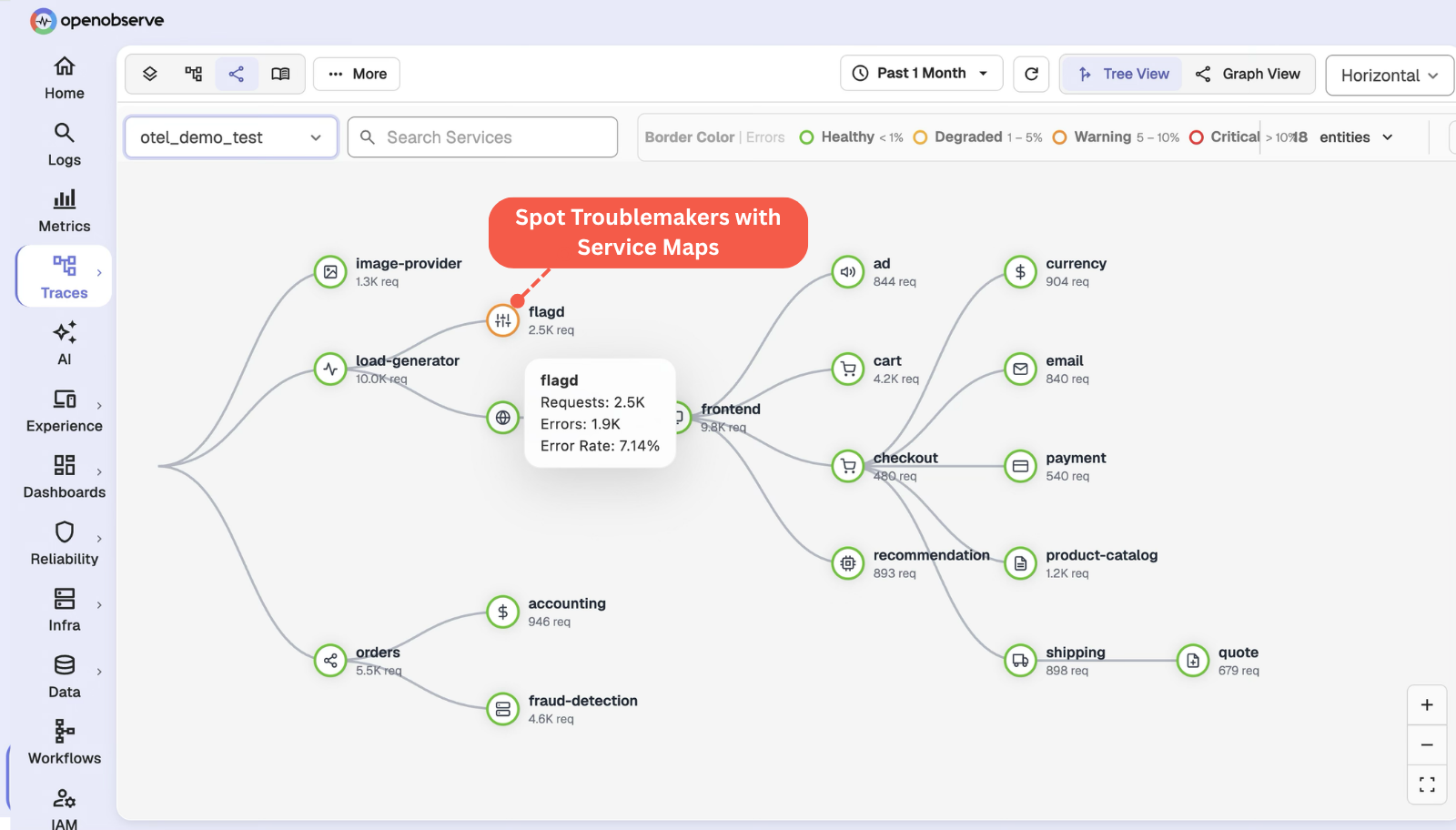
Yes. OpenObserve is an open-source (AGPL-3.0) observability platform that covers what teams use Datadog and New Relic for, without per-host or per-user fees. It stores data as compressed Parquet on object storage, which delivers approximately 140x lower storage costs in typical log workloads compared to Elasticsearch-based stacks; actual results vary based on data entropy and cardinality.
| | Datadog | New Relic | OpenObserve |
| --- | --- | --- | --- |
| Pricing | Per host + per product + per data unit | Per GB + per user | Per GB ingested, no host or user fees |
| Instrumentation | Datadog Agent and libraries, OTLP | New Relic agents, OTLP | OpenTelemetry, Fluent Bit, Vector, Prometheus |
| Query language | Datadog syntax | NRQL | SQL and PromQL |
| Deployment | SaaS | SaaS | Self-hosted, Kubernetes HA, or Cloud |
| License | Proprietary | Proprietary | AGPL-3.0 |
OpenObserve covers every area you'd use Datadog or New Relic for:
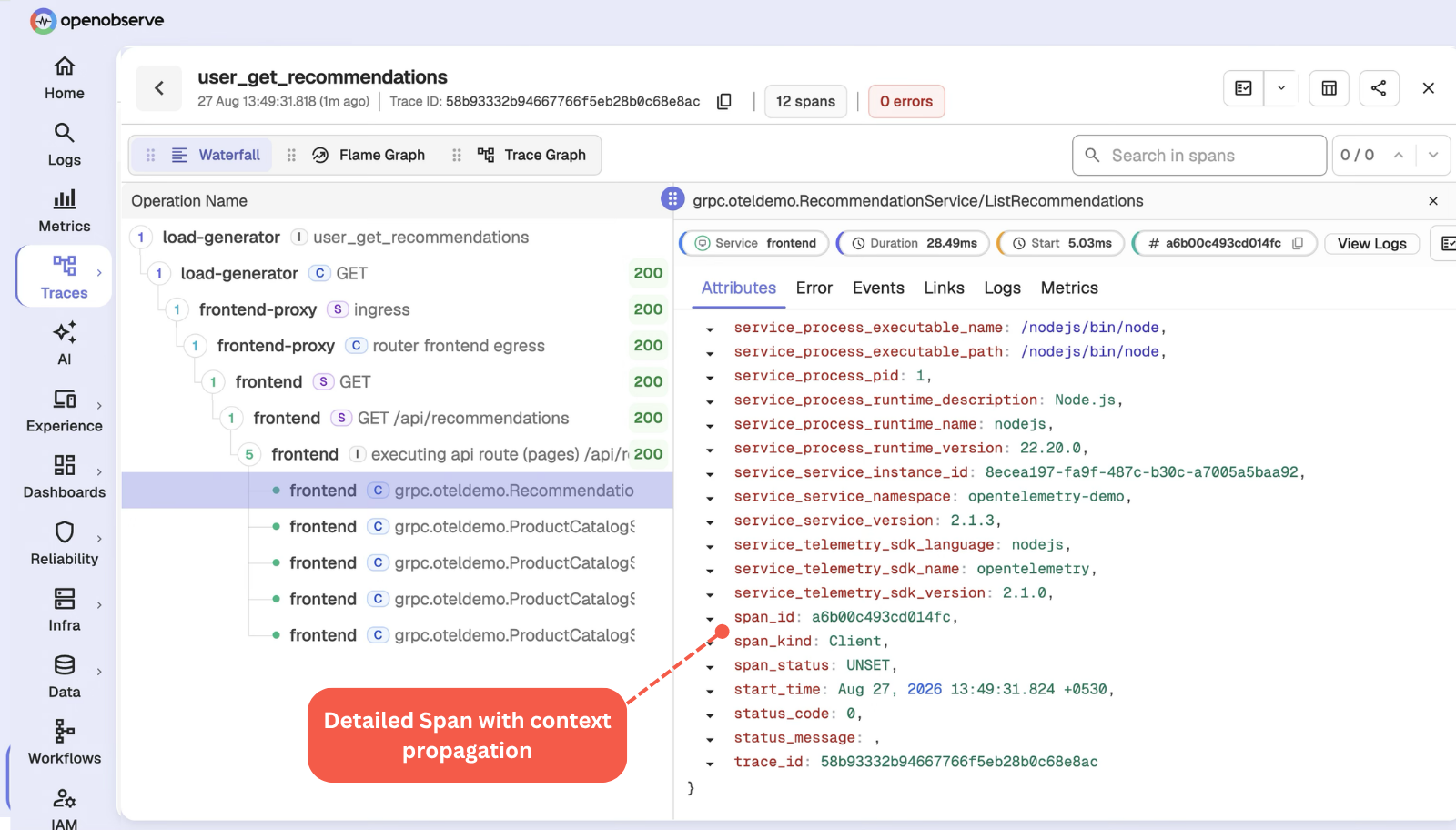
- **Telemetry:** logs, metrics, and traces with a service graph and service catalog, plus continuous profiling.
- **Frontend:** RUM, session replay, and error tracking.
- **Synthetic monitoring:** browser tests and HTTP, TCP, TLS, and SSH checks.
- **AI:** the SRE Agent with AI root cause analysis, the AI Assistant, an MCP server, LLM observability and evaluations, anomaly detection, log patterns, and insights.
- **Alerting and reliability:** scheduled, real-time, composite, and anomaly alerts; incident management; SLOs with error budgets and burn-rate alerts.
- **Dashboards and reports**, including scheduled PDF, PNG, or CSV reports.
- **Data processing:** pipelines, VRL functions, enrichment tables, and downsampling.
- **Storage and cost:** object storage, Bring Your Own Bucket, extended retention, and ingest-based pricing with no per-host or per-user fees.
- **Security and governance:** SSO, RBAC, multi-tenancy, sensitive data redaction, audit trail, cipher keys, and federated search.
- **Compliance:** SOC 2 Type II, ISO 27001, and GDPR via the EU region.
- **Open standards:** OpenTelemetry-native ingestion, SQL and PromQL, and open source under AGPL-3.0.
Every trace keeps its full span detail, with links straight to the related logs and metrics:
For deeper comparisons, see [OpenObserve vs Datadog](/datadog-alternative/), [OpenObserve vs New Relic](/newrelic-alternative/), the [New Relic alternatives list](/blog/top-10-new-relic-alternatives/), and the [Datadog alternatives list](/blog/top-10-datadog-alternative-tools/).
## How do you migrate from Datadog or New Relic to OpenObserve?
Migration is mostly a change of destination, not a change of instrumentation, if you route data through the OpenTelemetry Collector. A typical move takes these steps:
1. **Deploy the OpenTelemetry Collector** next to your existing agents, or use the OTLP support you already have in Datadog or New Relic.
2. **Add an OpenObserve exporter** and send traces, metrics, and logs to both platforms in parallel, following the [OpenTelemetry ingestion docs](https://openobserve.ai/docs/ingestion/traces/opentelemetry/):
```yaml
exporters:
otlphttp/openobserve:
endpoint: https:///api/
headers:
Authorization: Basic
stream-name: default
```
3. **Translate queries.** NRQL `SELECT count(*) FROM Log FACET service` becomes SQL `SELECT service, COUNT(*) FROM logs GROUP BY service`; Datadog log facets become `WHERE` filters.
4. **Rebuild dashboards and alerts** in OpenObserve with SQL and PromQL. The [dashboard migration guide](/blog/migrate-dashboards-datadog-grafana-kibana-cloudwatch-openobserve/) covers Datadog dashboards, and the [Datadog to OpenObserve migration docs](https://openobserve.ai/docs/migration/migrate-from-datadog-to-openobserve/) cover every signal.
5. **Compare data and cost** for two to four weeks, then retire the vendor agents.
## Get started with OpenObserve
The fastest way to compare is to send one service's telemetry to OpenObserve alongside Datadog or New Relic and look at the experience and the bill side by side.
- **Try it:** start a 14-day free trial on [OpenObserve Cloud](https://cloud.openobserve.ai).
- **Run it yourself:** follow the [OpenObserve quickstart](https://openobserve.ai/docs/getting-started/) for a single binary or Kubernetes.
- **Read next:** the [Datadog vs OpenObserve cost breakdown](/blog/datadog-vs-openobserve-part-9-cost/) and [Grafana vs Datadog](/blog/grafana-vs-datadog/).
## Frequently Asked Questions
### What is the difference between Datadog and New Relic?
Both are SaaS observability platforms covering infrastructure, APM, logs, browser monitoring, and synthetics. Datadog sells each capability as a separate product priced per host or per unit of data. New Relic sells one platform priced per GB of data ingested plus per user, with no per-host fees. Datadog uses its own query syntax; New Relic uses NRQL.
### Does Datadog or New Relic cost less?
It depends on your host count, data volume, and team size. Datadog costs grow with hosts and indexed log events: Infrastructure Pro is $15 and APM $31 per host per month on annual billing. New Relic costs grow with data and users: $0.40 per GB beyond 100 free GB a month, plus $349 per full platform user per month on the Pro edition. Large teams with few hosts often pay less on Datadog; small teams with many hosts often pay less on New Relic. OpenObserve avoids both multipliers with ingest-based pricing and no per-host or per-user fees.
### Which is better, Datadog or New Relic?
Neither is better for every team. Datadog suits teams with a modest, stable fleet and many engineers who need full access, and teams that want the widest integration catalog. New Relic suits teams with many hosts or containers and a small group of full platform users, and teams that want one query language, NRQL, for all data. Teams that want neither host fees nor seat fees choose OpenObserve, which bills only per GB ingested.
### What contract terms do Datadog and New Relic offer?
Datadog lists annual, month-to-month, and on-demand prices, and annual is lowest, for example $15 versus $18 per host per month for Infrastructure Pro. New Relic Standard and Pro can be paid as you go with monthly billing and no commitment, and Pro full platform users cost $349 per month on an annual commitment versus $418.80 pay as you go. Pro and Enterprise customers can also buy an annual or multi-year savings plan, a pool of funds where unused funds roll over for up to 12 months.
### Does New Relic charge per host?
No. New Relic's pricing page states that hosts, agents, and containers are included at no additional cost. You pay for data ingested beyond the free 100 GB a month and for core and full platform users. Datadog charges per host for Infrastructure Monitoring and APM.
### Which is better for APM, Datadog or New Relic?
Both offer mature APM with distributed tracing, service maps, and code-level visibility, and both accept OpenTelemetry data. Datadog bills APM per host plus span ingestion and indexing; New Relic includes APM in its per-GB and per-user pricing. Teams that want OpenTelemetry-native APM without per-host or per-user fees often choose OpenObserve.
### What is a cost-efficient alternative to Datadog and New Relic?
OpenObserve is an open-source observability platform for logs, metrics, traces, RUM, and synthetics, with SQL and PromQL querying and no per-host or per-user fees. OpenObserve Cloud costs $0.50 per GB ingested on an annual contract ($0.70 pay as you go), with 30 days of searchable retention included. It ingests OpenTelemetry natively, so you can migrate by changing exporters.