---
title: Quarkus LangChain4j
description: Instrument Quarkus LangChain4j applications and send traces to OpenObserve via OpenTelemetry.
---
# **Quarkus LangChain4j → OpenObserve**
Capture LLM call latency, token usage, prompt content, completion content, and model metadata for every AI service call in a Quarkus application. Quarkus LangChain4j integrates LangChain4j with Quarkus's native OpenTelemetry extension. Add the `quarkus-opentelemetry` extension, configure your OTLP endpoint, and every `@RegisterAiService` call is automatically traced with `gen_ai.*` attributes and a nested HTTP client span.
## **Prerequisites**
* Java 17+
* Maven 3.9+
* An [OpenObserve](https://openobserve.ai/) account (cloud or self-hosted)
* Your OpenObserve **organisation ID** and **Base64-encoded auth token**
* An OpenAI API key
## **Installation**
Add the following to your `pom.xml`:
```xml
io.quarkus.platform
quarkus-bom
3.22.3
pom
import
io.quarkiverse.langchain4j
quarkus-langchain4j-bom
0.26.1
pom
import
io.quarkiverse.langchain4j
quarkus-langchain4j-openai
io.quarkus
quarkus-opentelemetry
```
## **Configuration**
Set the following in `src/main/resources/application.properties`:
```properties
quarkus.application.name=quarkus-langchain4j
quarkus.otel.service.name=quarkus-langchain4j
quarkus.otel.exporter.otlp.protocol=http/protobuf
quarkus.otel.exporter.otlp.endpoint=https://api.openobserve.ai/api/your_org_id
quarkus.otel.exporter.otlp.headers=Authorization=Basic
quarkus.langchain4j.openai.api-key=${OPENAI_API_KEY}
quarkus.langchain4j.openai.chat-model.model-name=gpt-4o-mini
quarkus.langchain4j.openai.timeout=30s
quarkus.langchain4j.tracing.include-prompt=true
quarkus.langchain4j.tracing.include-completion=true
```
## **Instrumentation**
Define an AI service interface with `@RegisterAiService`. In command mode, wrap calls inside an `@ApplicationScoped` runner bean annotated with `@ActivateRequestContext` so the CDI request scope is active when the AI service bean is invoked.
**AiService.java**
```java
import dev.langchain4j.service.UserMessage;
import io.quarkiverse.langchain4j.RegisterAiService;
@RegisterAiService
public interface AiService {
String ask(@UserMessage String question);
}
```
**Runner.java**
```java
import jakarta.enterprise.context.ApplicationScoped;
import jakarta.enterprise.context.control.ActivateRequestContext;
import jakarta.inject.Inject;
@ApplicationScoped
public class Runner {
@Inject
AiService aiService;
@ActivateRequestContext
public void run() {
String answer = aiService.ask("What is distributed tracing?");
System.out.println(answer);
}
}
```
**Main.java**
```java
import io.quarkus.runtime.QuarkusApplication;
import io.quarkus.runtime.annotations.QuarkusMain;
import jakarta.inject.Inject;
@QuarkusMain
public class Main implements QuarkusApplication {
@Inject
Runner runner;
@Override
public int run(String... args) throws Exception {
runner.run();
return 0;
}
}
```
Build and run:
```shell
mvn package
export OPENAI_API_KEY=your-key
java -jar target/quarkus-app/quarkus-run.jar
```
## **What Gets Captured**
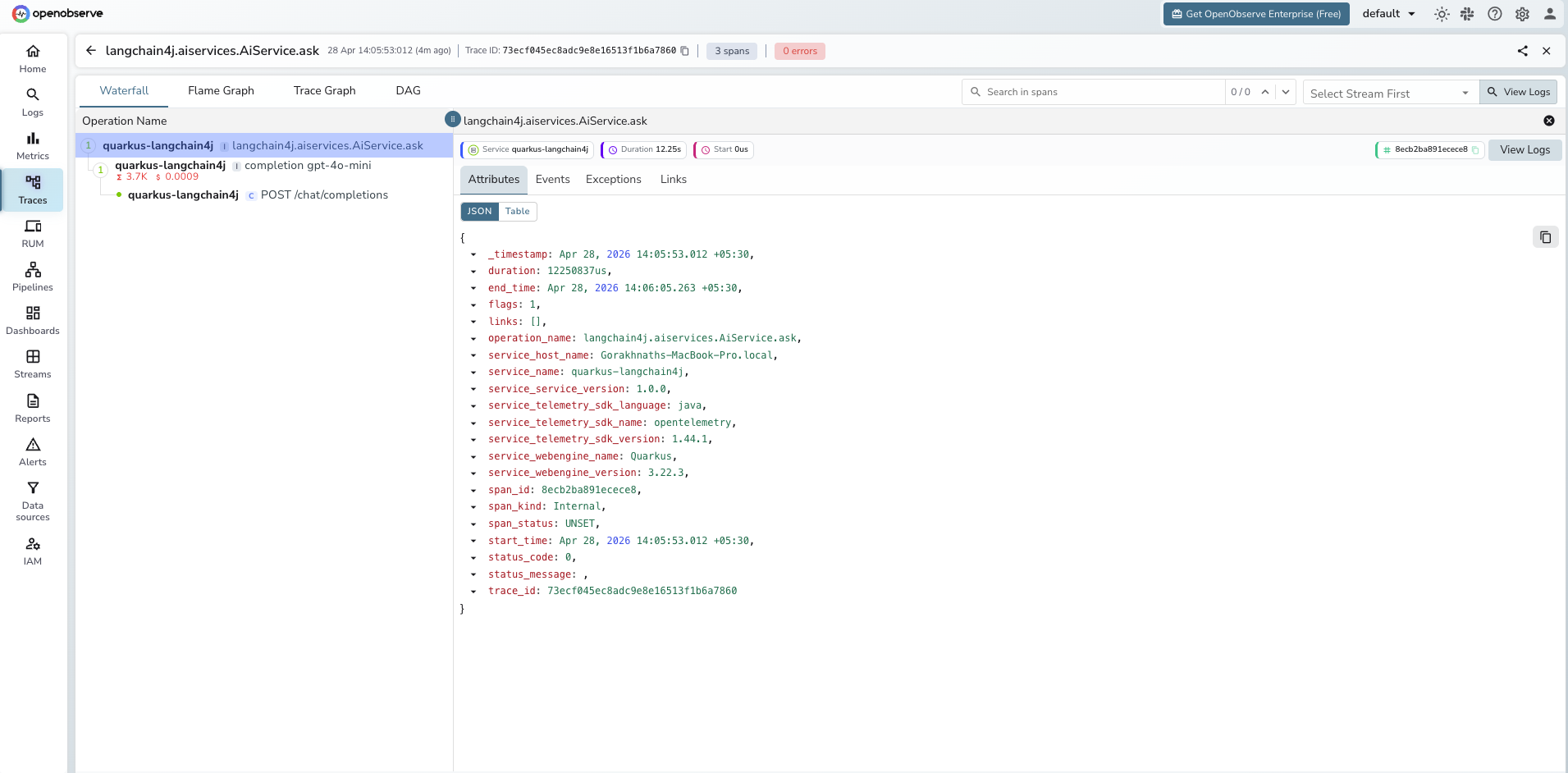
Each AI service call produces two spans: a root `langchain4j.aiservices..` span and a child `completion ` span. A third HTTP client span is nested under the completion span.
**`langchain4j.aiservices.AiService.ask` span (root)**
| Attribute | Description |
| ----- | ----- |
| `operation_name` | Always `langchain4j.aiservices..` |
| `span_status` | `UNSET` on success, `ERROR` on exception |
| `duration` | End-to-end latency including the LLM call |
**`completion ` span (LLM call)**
| Attribute | Description |
| ----- | ----- |
| `gen_ai_request_model` | Model name passed in the request (e.g. `gpt-4o-mini`) |
| `gen_ai_response_model` | Resolved model name returned by the provider |
| `gen_ai_response_finish_reasons` | Why generation stopped (e.g. `STOP`) |
| `gen_ai_response_id` | Provider response ID |
| `gen_ai_usage_prompt_tokens` | Prompt tokens consumed |
| `gen_ai_usage_completion_tokens` | Completion tokens generated |
| `gen_ai_client_estimated_cost` | Estimated cost string (e.g. `0.00056000USD`) |
| `llm_input` | Prompt text (requires `include-prompt=true`) |
| `llm_output` | Completion text (requires `include-completion=true`) |
| `llm_usage_tokens_input` | Input tokens (numeric) |
| `llm_usage_tokens_output` | Output tokens (numeric) |
| `llm_usage_tokens_total` | Total tokens (numeric) |
| `llm_usage_cost_input` | Estimated cost for input tokens |
| `llm_usage_cost_output` | Estimated cost for output tokens |
| `span_status` | `UNSET` on success, `ERROR` on exception |
| `duration` | LLM call latency |
## **Viewing Traces**
1. Log in to OpenObserve and navigate to **Traces**
2. Filter by `service_name = quarkus-langchain4j` to isolate spans
3. Click a `langchain4j.aiservices.AiService.ask` trace to expand the full span tree
4. Inspect the nested `completion` span for token counts and cost
5. Filter by `span_status = ERROR` to find failed AI service calls
## **Next Steps**
With Quarkus LangChain4j instrumented, every AI service call is recorded in OpenObserve. From here you can track token consumption per service method, build cost dashboards, and set alerts on latency regressions.
## **Read More**
- [LLM Observability Overview](../llm-applications.md)
- [Spring AI](./spring-ai.md)
- [Exploring Traces in OpenObserve](../../../user-guide/data-exploration/traces/index.md)
- [Building Dashboards](../../../user-guide/analytics/dashboards/index.md)