
Import and Export Pipelines
This guide explains how to import and export pipelines. Use this feature to replicate existing pipelines across environments without recreating them from scratch.
Export a pipeline
To export an existing pipeline configuration:
- From the left navigation menu, go to Data > Pipelines.
- In the Pipelines tab, locate the pipeline you want to export.
- In the Actions column of the pipeline, click More actions (⋮) and select Export. You can also hover over the row and press
x. To export several pipelines at once, select their rows and click Export in the selection bar.
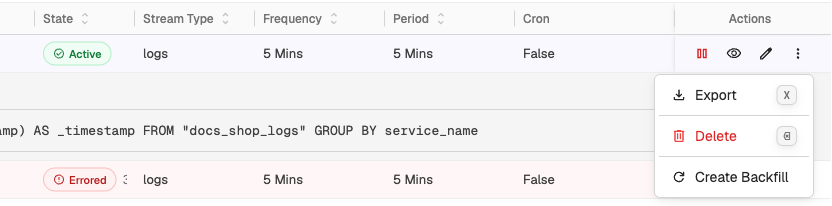 The downloaded file is named
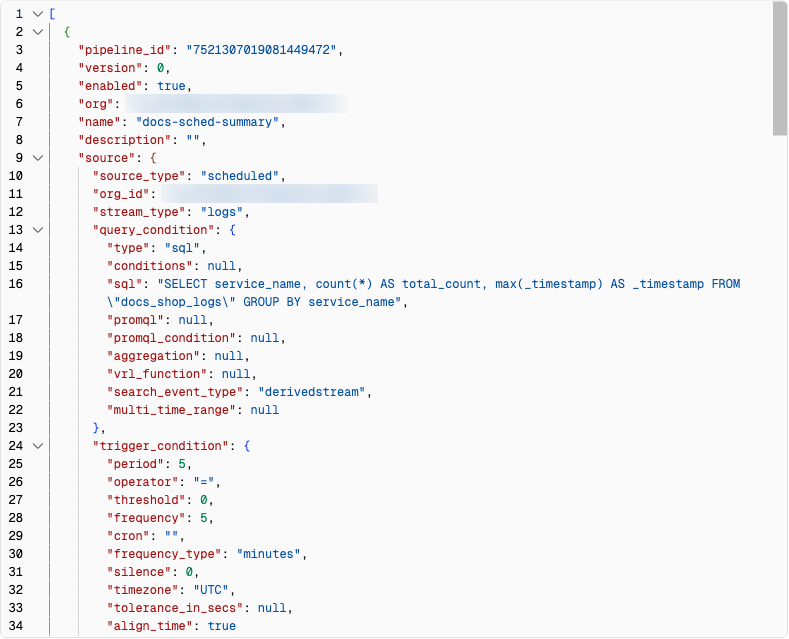
<pipeline-name>.jsonfor one pipeline, orpipelines_export_<date>.jsonfor several. It contains the pipeline configuration and can be used to import the pipeline into another environment. It also carries the functions the pipeline uses, so the import can create them in the target organization.
Exporting the pipelinescheduled-pipeline-demogenerates a JSON file similar to the following:
Import a pipeline
To import a previously exported pipeline:
-
Go to Data > Pipelines.
-
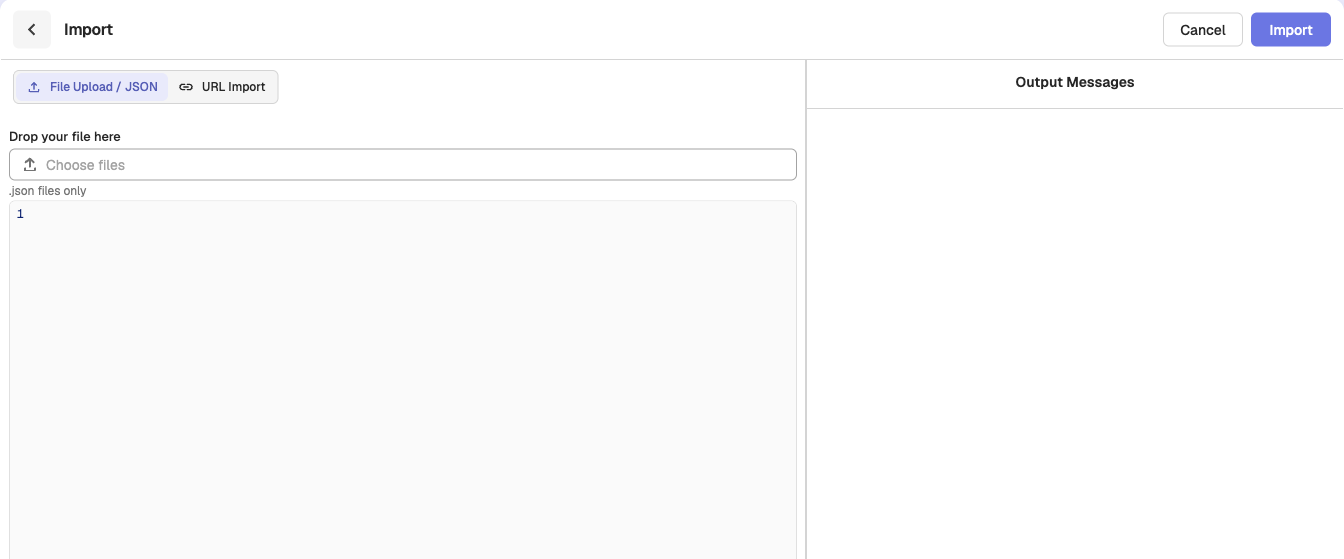
Open the More actions menu (☰) in the top-right corner and select Import, or press
i. -
Choose one of the supported import methods:
- File Upload / JSON: Upload one or more JSON files containing pipeline configurations from your local system, or paste the JSON pipeline definition in the JSON editor.
- URL Import: Provide a URL to fetch the pipeline configuration.
-
To import pipelines in bulk, choose multiple JSON files.
-
Click Import. The imported pipeline appears in the Pipelines tab.
Handle validation errors while importing pipelines
If any validation errors occur during import, they are listed under Error Validations, with a field to correct each value in place. Refer to the following resolutions:
- Pipeline name already exists: Enter a unique pipeline name.
- Source stream name already exists: Enter a unique source stream.
- Source stream type does not exist: Enter stream type.
- Source time zone does not exist (for scheduled pipeline): Ensure the source time zone is accurate when you want to import scheduled pipelines.
- The SQL query does not exist (for scheduled pipeline): Ensure the SQL query exists if you want to import scheduled pipelines.
- Destination stream type does not exist: Enter the destination stream type.
- Organization ID does not exist: Enter the organization ID.
- Function name does not exist: Enter the function name, or import a file that includes the function. If a function in the file has the same name as an existing function but different logic, OpenObserve creates a copy under a new name and uses it in the imported pipeline.
- Remote Destination does not exist: Ensure the remote destination is accurate.
Related links
Remote Destination
Configure remote destinations to send transformed pipeline data to external systems, with persistent queuing, retry logic, and high throughput.
Manage Pipelines
Manage, filter, search, edit, pause, or delete real-time and scheduled pipelines in OpenObserve using the intuitive pipeline list and actions panel.