
Portkey → OpenObserve
Automatically capture token usage, latency, and model metadata for every request routed through the Portkey AI gateway. Portkey exposes an OpenAI-compatible API, so instrumentation uses the standard OpenAI instrumentor pointed at the Portkey endpoint.
Prerequisites
- Python 3.8+
- An OpenObserve account (cloud or self-hosted)
- Your OpenObserve organisation ID and Base64-encoded auth token
- A Portkey API key and a configured provider
Installation
pip install openobserve-telemetry-sdk openinference-instrumentation-openai openai python-dotenvConfiguration
Create a .env file in your project root:
OPENOBSERVE_URL=https://api.openobserve.ai/
OPENOBSERVE_ORG=your_org_id
OPENOBSERVE_AUTH_TOKEN=Basic <your_base64_token>
PORTKEY_API_KEY=your-portkey-api-key
OPENAI_API_KEY=your-openai-api-key
Instrumentation
Call OpenAIInstrumentor().instrument() before creating the OpenAI client. Pass the Portkey API key and provider routing headers.
from dotenv import load_dotenv
load_dotenv()

from openinference.instrumentation.openai import OpenAIInstrumentor
from openobserve import openobserve_init

OpenAIInstrumentor().instrument()
openobserve_init()

import os
from openai import OpenAI

client = OpenAI(
    api_key=os.environ["PORTKEY_API_KEY"],
    base_url="https://api.portkey.ai/v1",
    default_headers={
        "x-portkey-api-key": os.environ["PORTKEY_API_KEY"],
        "x-portkey-provider": "openai",
        "Authorization": f"Bearer {os.environ['OPENAI_API_KEY']}",
    },
)

response = client.chat.completions.create(
    model="gpt-4o-mini",
    messages=[{"role": "user", "content": "Explain distributed tracing in one sentence."}],
)
print(response.choices[0].message.content)
Using Portkey virtual keys
If you have configured virtual keys in Portkey, you can use them instead of passing provider credentials directly:
client = OpenAI(
    api_key=os.environ["PORTKEY_API_KEY"],
    base_url="https://api.portkey.ai/v1",
    default_headers={
        "x-portkey-api-key": os.environ["PORTKEY_API_KEY"],
        "x-portkey-virtual-key": os.environ["PORTKEY_VIRTUAL_KEY"],
    },
)
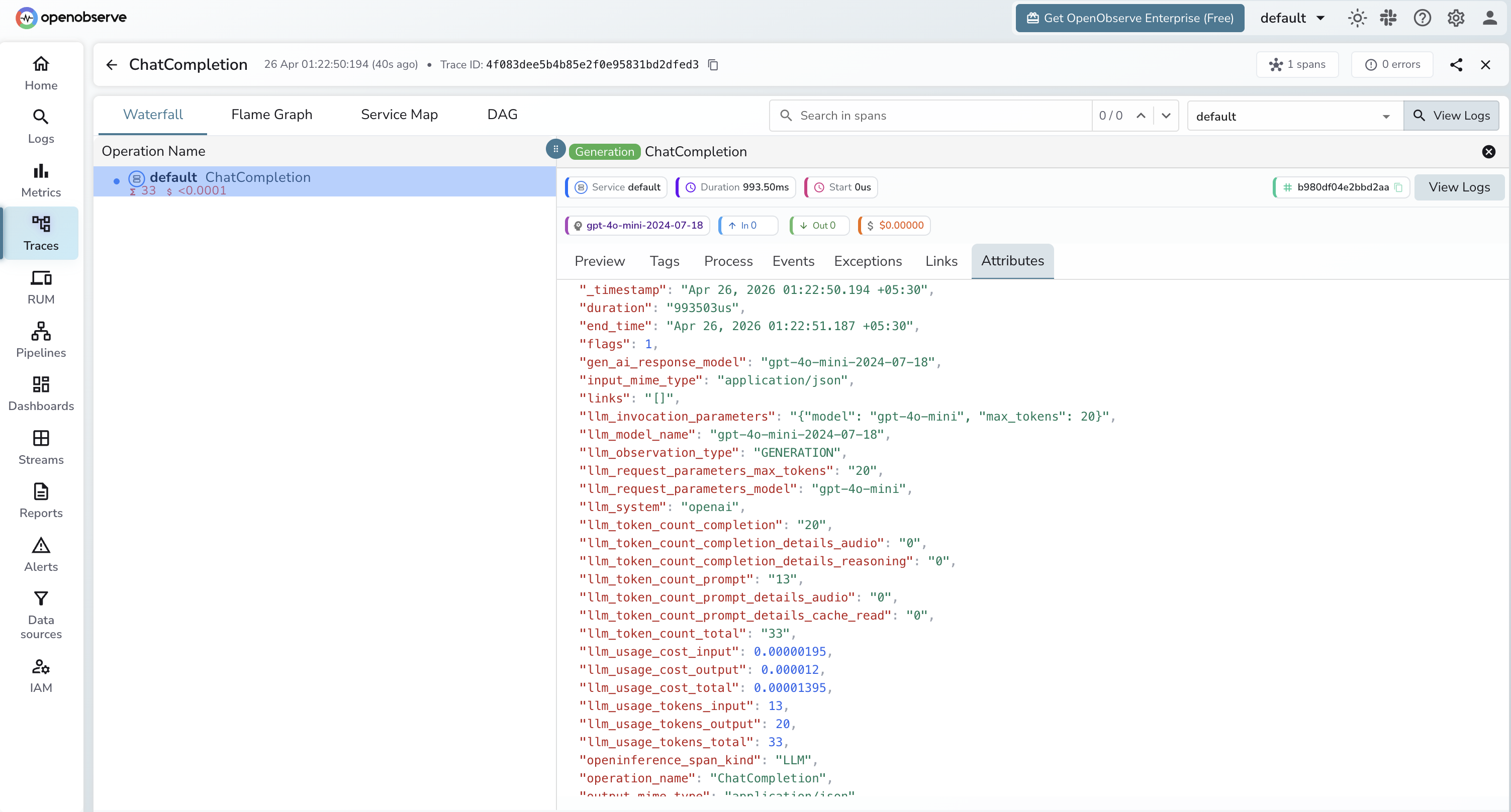
What Gets Captured
| Attribute | Description |
|---|---|
llm_model_name | Resolved model name (e.g. gpt-4o-mini-2024-07-18) |
llm_request_parameters_model | Requested model (e.g. gpt-4o-mini) |
gen_ai_response_model | Model that served the response |
llm_system | openai (the client library used) |
llm_token_count_prompt | Tokens in the prompt |
llm_token_count_completion | Tokens in the response |
llm_token_count_total | Total tokens consumed |
openinference_span_kind | LLM |
operation_name | ChatCompletion |
duration | End-to-end request latency |
span_status | OK or error status |
Viewing Traces
- Log in to OpenObserve and navigate to Traces
- Click any span to inspect token counts, model, and latency
- Use
llm_model_nameto compare different providers routed through Portkey
Next Steps
With Portkey instrumented, every routed request is recorded in OpenObserve. From here you can compare latency and cost across providers, monitor fallback behaviour, and set alerts on error rates.
Read More
Was this page helpful?
Last updated on