
Cognee → OpenObserve
Capture latency and result counts for every Cognee knowledge graph ingest and search operation. Cognee is a Python framework that builds structured knowledge graphs from unstructured text for AI applications. Instrumentation uses manual OpenTelemetry spans wrapping each add, cognify, and search call.
Prerequisites
- Python 3.9+
- An OpenObserve account (cloud or self-hosted)
- Your OpenObserve organisation ID and Base64-encoded auth token
- An OpenAI API key (used by Cognee for embeddings and LLM reasoning)
Installation
pip install openobserve-telemetry-sdk cognee opentelemetry-api python-dotenvConfiguration
Create a .env file in your project root:
OPENOBSERVE_URL=https://api.openobserve.ai/
OPENOBSERVE_ORG=your_org_id
OPENOBSERVE_AUTH_TOKEN=Basic <your_base64_token>
OPENAI_API_KEY=your-openai-api-key
Instrumentation
Call openobserve_init() before calling Cognee. Wrap each pipeline stage in a manual span.
from dotenv import load_dotenv
load_dotenv()

from openobserve import openobserve_init
openobserve_init()

from opentelemetry import trace
import os
import asyncio
import cognee
from cognee import SearchType

tracer = trace.get_tracer(__name__)

cognee.config.set_llm_config({
    "llm_provider": "openai",
    "llm_model": "gpt-4o-mini",
    "llm_api_key": os.environ["OPENAI_API_KEY"],
})


async def main():
    with tracer.start_as_current_span("cognee.ingest") as span:
        await cognee.prune.prune_data()
        await cognee.add([
            "OpenObserve is an observability platform for logs, metrics, and traces.",
            "OpenTelemetry is a vendor-neutral standard for telemetry data.",
        ])
        await cognee.cognify()
        span.set_attribute("cognee.document_count", 2)

    with tracer.start_as_current_span("cognee.search") as span:
        query = "What is OpenObserve?"
        span.set_attribute("cognee.query", query)
        results = await cognee.search(SearchType.SUMMARIES, query)
        span.set_attribute("cognee.result_count", len(results))
        for r in results:
            print(r.get("text", r))


asyncio.run(main())
Search types
Cognee supports three search types via the SearchType enum:
from cognee import SearchType

# Return AI-generated summaries of matching documents
results = await cognee.search(SearchType.SUMMARIES, "What is RAG?")

# Return raw document chunks
results = await cognee.search(SearchType.CHUNKS, "What is RAG?")

# Return knowledge graph insights
results = await cognee.search(SearchType.INSIGHTS, "What is RAG?")
What Gets Captured
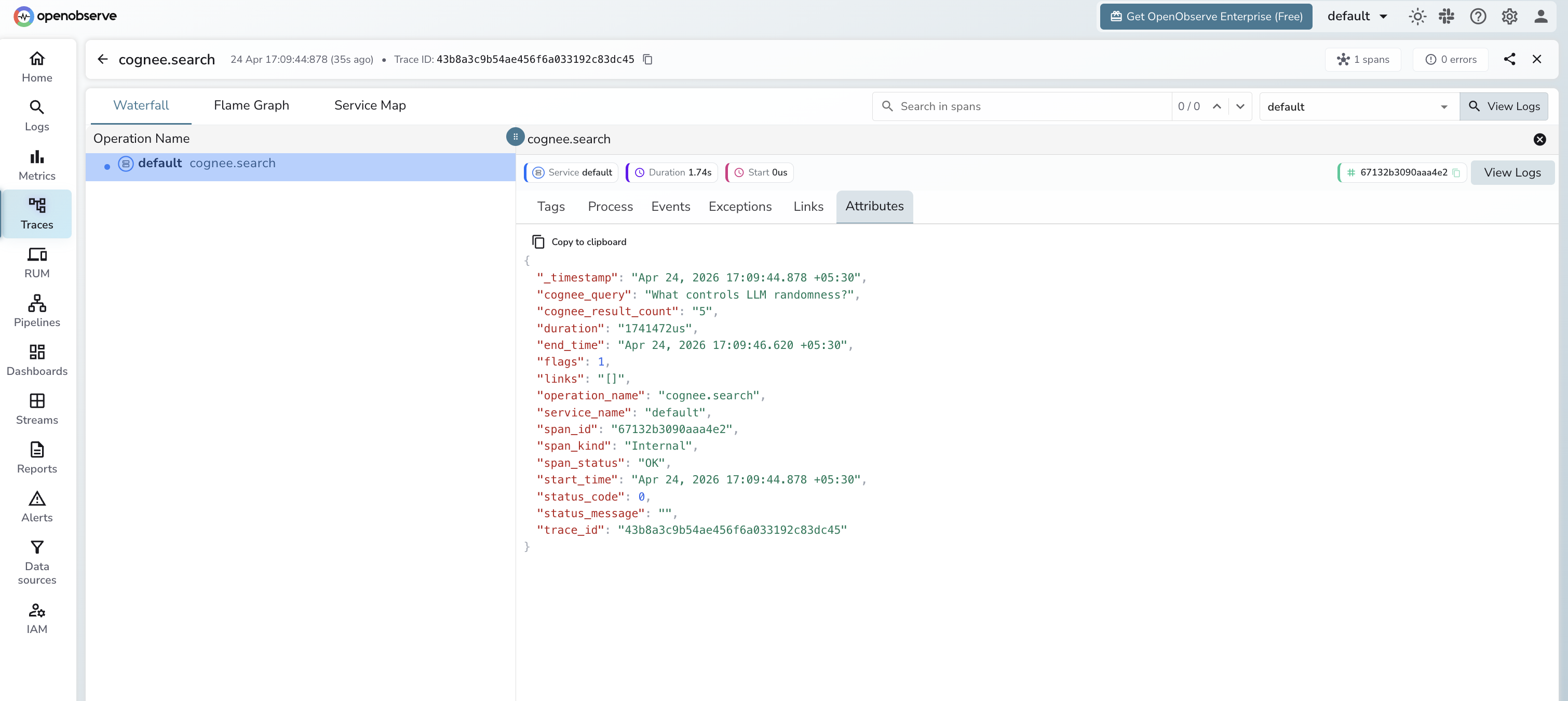
Each operation wrapped in a span produces the following attributes. OpenObserve stores dot-separated attribute names with underscores.
| Attribute (in OpenObserve) | Description |
|---|---|
operation_name | cognee.search or cognee.ingest |
cognee_query | The search query string |
cognee_result_count | Number of results returned |
cognee_document_count | Number of documents ingested |
duration | End-to-end operation latency |
span_status | OK on success, ERROR on failure |
Viewing Traces
- Log in to OpenObserve and navigate to Traces in the left sidebar
- Filter by
operation_name = cognee.searchto see all search spans - Click any span to inspect
cognee_queryandcognee_result_count - Sort by duration to identify slow ingest or search operations
Next Steps
With Cognee instrumented, every knowledge graph operation in your AI pipeline is recorded in OpenObserve. From here you can monitor ingest throughput, track search latency, and correlate Cognee search spans with downstream LLM generation spans.
Read More
Last updated on