
mcp-use → OpenObserve
Capture agent run latency, prompt input, result length, and error details for every mcp-use agent invocation. mcp-use is a Python library that connects LLM agents to Model Context Protocol (MCP) servers. Instrumentation uses manual OpenTelemetry spans wrapping each agent run.
Prerequisites
- Python 3.11+ (required by
mcp-use) - An OpenObserve account (cloud or self-hosted)
- Your OpenObserve organisation ID and Base64-encoded auth token
- Node.js installed (for running MCP servers via
npx) - An OpenAI API key
Installation
pip install openobserve-telemetry-sdk mcp-use langchain-openai opentelemetry-api python-dotenvConfiguration
Create a .env file in your project root:
OPENOBSERVE_URL=http://localhost:5080/
OPENOBSERVE_ORG=default
OPENOBSERVE_AUTH_TOKEN=Basic <your_base64_token>
OPENAI_API_KEY=your-openai-api-key
Instrumentation
Call openobserve_init() before importing mcp_use. Wrap each agent.run() call in a manual span.
from dotenv import load_dotenv
load_dotenv()

from openobserve import openobserve_init
openobserve_init()

from opentelemetry import trace
import os
import asyncio
from mcp_use import MCPClient, MCPAgent
from langchain_openai import ChatOpenAI

tracer = trace.get_tracer(__name__)

config = {
    "mcpServers": {
        "filesystem": {
            "command": "npx",
            "args": ["-y", "@modelcontextprotocol/server-filesystem", "/tmp"],
        }
    }
}

llm = ChatOpenAI(model="gpt-4o-mini", api_key=os.environ["OPENAI_API_KEY"])

async def run(prompt: str):
    with tracer.start_as_current_span("mcp_use.agent_run") as span:
        span.set_attribute("mcp_use.prompt", prompt[:200])
        span.set_attribute("mcp_use.server", "filesystem")
        try:
            client = MCPClient(config)
            agent = MCPAgent(llm=llm, client=client, max_steps=5)
            result = await agent.run(prompt)
            span.set_attribute("mcp_use.result_length", len(str(result)))
            span.set_attribute("span_status", "OK")
            return result
        except Exception as e:
            span.set_attribute("span_status", "ERROR")
            span.set_attribute("error.message", str(e)[:200])
            raise

async def main():
    result = await run("What directories are available in /tmp?")
    print(result)
    trace.get_tracer_provider().force_flush()

asyncio.run(main())
What Gets Captured
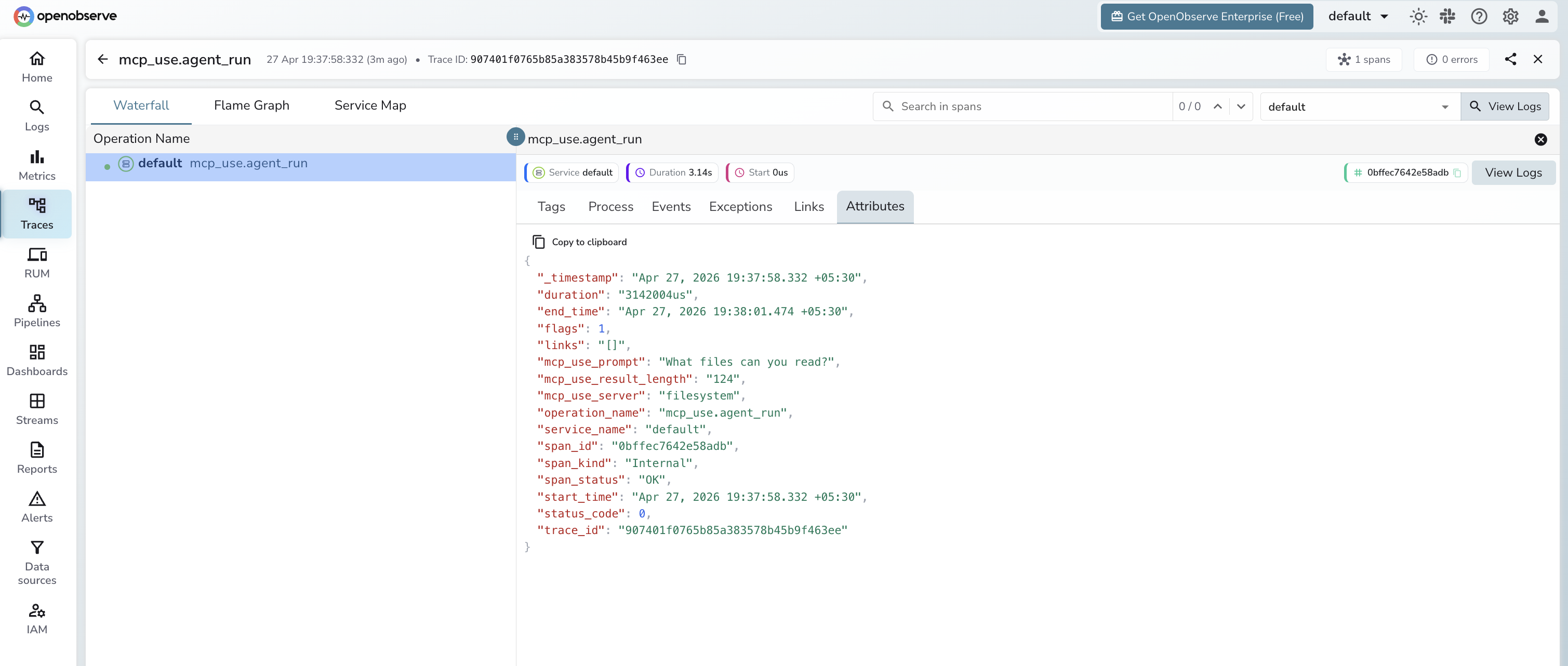
| Attribute | Description |
|---|---|
operation_name | mcp_use.agent_run |
mcp_use_prompt | The user prompt sent to the agent (truncated to 200 chars) |
mcp_use_server | Name of the MCP server being used (e.g. filesystem) |
mcp_use_result_length | Character count of the agent's final result |
span_status | OK on success, ERROR on failure |
error_message | Error detail when the agent run fails |
duration | End-to-end agent execution latency |
Viewing Traces
- Log in to OpenObserve and navigate to Traces
- Filter by
operation_name=mcp_use.agent_runto see all agent runs - Filter by
span_status=ERRORto find failed runs - Sort by duration to identify slow agent invocations
Next Steps
With mcp-use instrumented, every agent run connecting to MCP servers is recorded in OpenObserve. From here you can monitor agent execution time, track error rates by server, and correlate runs with specific prompts.
Read More
Was this page helpful?
Last updated on