n8n → OpenObserve
Capture webhook trigger latency, status codes, and payload metadata for every n8n workflow invocation. n8n is a self-hosted workflow automation platform. Instrumentation wraps n8n webhook calls in manual OpenTelemetry spans, and n8n can also export native workflow traces via OTLP environment variables.
Prerequisites
- Python 3.8+
- An OpenObserve account (cloud or self-hosted)
- Your OpenObserve organisation ID and Base64-encoded auth token
- A running n8n instance with at least one active webhook workflow
Installation
pip install openobserve-telemetry-sdk opentelemetry-api requests python-dotenvConfiguration
Create a .env file in your project root:
OPENOBSERVE_URL=https://api.openobserve.ai/
OPENOBSERVE_ORG=your_org_id
OPENOBSERVE_AUTH_TOKEN=Basic <your_base64_token>
N8N_BASE_URL=http://localhost:5678
N8N_WEBHOOK_ID=your-webhook-path
To capture native n8n workflow execution traces alongside the manual spans, start n8n with these environment variables:
docker run -p 5678:5678 \
  -e N8N_METRICS=true \
  -e OTEL_EXPORTER_OTLP_ENDPOINT=http://host.docker.internal:5080/api/default/v1/traces \
  -e "OTEL_EXPORTER_OTLP_HEADERS=Authorization=Basic <your_base64_token>" \
  -e OTEL_SERVICE_NAME=n8n \
  n8nio/n8n
Instrumentation
Call openobserve_init() before making API calls. Wrap each webhook trigger in a manual span.
from dotenv import load_dotenv
load_dotenv()

from openobserve import openobserve_init
openobserve_init()

from opentelemetry import trace
import os
import requests

tracer = trace.get_tracer(__name__)

base_url = os.environ.get("N8N_BASE_URL", "http://localhost:5678")
webhook_id = os.environ["N8N_WEBHOOK_ID"]

def trigger_webhook(payload: dict):
    with tracer.start_as_current_span("n8n.webhook_trigger") as span:
        span.set_attribute("n8n.webhook_id", webhook_id)
        span.set_attribute("n8n.payload_keys", str(list(payload.keys())))
        resp = requests.post(
            f"{base_url}/webhook/{webhook_id}",
            headers={"Content-Type": "application/json"},
            json=payload,
            timeout=30,
        )
        span.set_attribute("n8n.status_code", resp.status_code)
        span.set_attribute("span_status", "OK" if resp.ok else "ERROR")
        return resp

result = trigger_webhook({"message": "Explain distributed tracing."})
print(result.status_code, result.text)
What Gets Captured
| Attribute | Description |
|---|---|
n8n_webhook_id | The webhook path being triggered |
n8n_payload_keys | Keys present in the webhook payload |
n8n_status_code | HTTP status code from n8n (200 on success) |
span_status | OK or error status |
error_message | Error detail on connection failures |
duration | Webhook trigger latency |
Viewing Traces
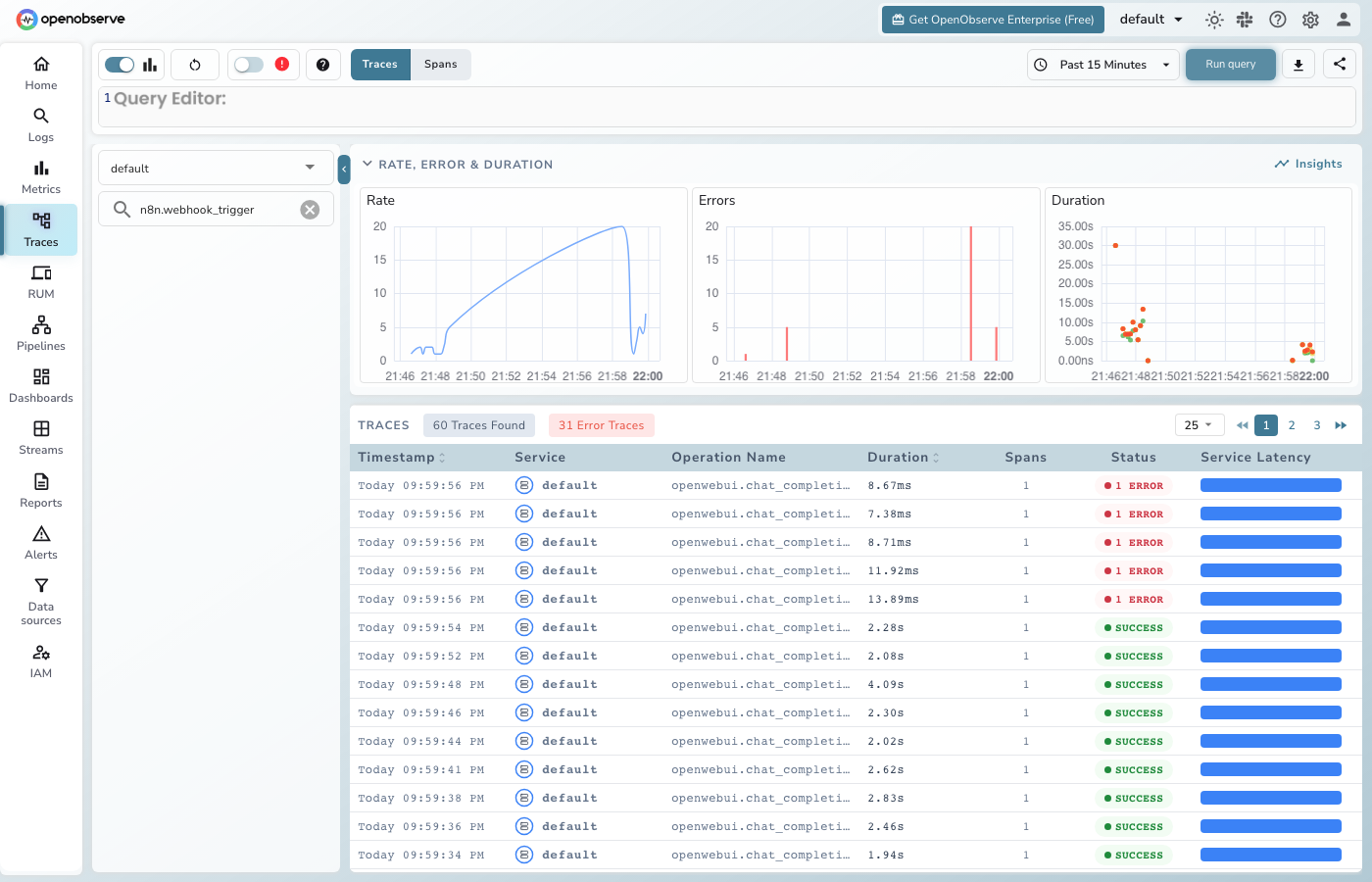
- Log in to OpenObserve and navigate to Traces
- Filter by span name
n8n.webhook_triggerto see all webhook calls - Filter by
n8n_status_codeto find non-200 responses - Filter by
span_statusERRORto find failed triggers
Next Steps
With n8n instrumented, every webhook trigger is recorded in OpenObserve. From here you can monitor trigger latency, track which webhooks are called most often, and set alerts on failed workflow invocations.
Read More
Last updated on