
Trubrics → OpenObserve
Capture LLM generation spans in OpenObserve while simultaneously recording user feedback events in Trubrics. Trubrics is a feedback collection platform for LLM applications. The two tools complement each other: Trubrics tracks thumbs up/down and free-text feedback; OpenObserve stores the full trace with token counts and latency.
Prerequisites
- Python 3.8+
- An OpenObserve account (cloud or self-hosted)
- Your OpenObserve organisation ID and Base64-encoded auth token
- A Trubrics API key
- An OpenAI API key
Installation
pip install openobserve-telemetry-sdk openinference-instrumentation-openai trubrics openai python-dotenvConfiguration
Create a .env file in your project root:
OPENOBSERVE_URL=https://api.openobserve.ai/
OPENOBSERVE_ORG=your_org_id
OPENOBSERVE_AUTH_TOKEN=Basic <your_base64_token>
OPENAI_API_KEY=your-openai-api-key
TRUBRICS_API_KEY=your-trubrics-api-key
Instrumentation
Call OpenAIInstrumentor().instrument() and openobserve_init() before creating any clients. Record user feedback in Trubrics alongside OTel generation spans.
from dotenv import load_dotenv
load_dotenv()

from openinference.instrumentation.openai import OpenAIInstrumentor
from openobserve import openobserve_init

OpenAIInstrumentor().instrument()
openobserve_init()

from opentelemetry import trace
import os
import uuid
from trubrics import Trubrics
from openai import OpenAI

tracer = trace.get_tracer(__name__)
tb = Trubrics(api_key=os.environ["TRUBRICS_API_KEY"])
client = OpenAI(api_key=os.environ["OPENAI_API_KEY"])

def generate_and_collect_feedback(prompt: str, user_id: str = None) -> str:
    with tracer.start_as_current_span("trubrics.llm_with_feedback") as span:
        span.set_attribute("trubrics.prompt", prompt[:200])
        span.set_attribute("trubrics.model", "gpt-4o-mini")

        response = client.chat.completions.create(
            model="gpt-4o-mini",
            messages=[{"role": "user", "content": prompt}],
            max_tokens=200,
        )
        reply = response.choices[0].message.content
        trace_id = hex(span.get_span_context().trace_id)
        span.set_attribute("trubrics.trace_id", trace_id)

        tb.track(
            user_id=user_id or str(uuid.uuid4()),
            prompt=prompt,
            generation=reply,
            tags={"model": "gpt-4o-mini", "trace_id": trace_id},
        )
        return reply

result = generate_and_collect_feedback(
    "Explain distributed tracing in one sentence.",
    user_id="user-123",
)
print(result)
What Gets Captured
In OpenObserve (OTel traces):
| Attribute | Description |
|---|---|
trubrics_prompt | The user prompt |
trubrics_model | Model used for generation |
trubrics_completion_length | Character length of the model response |
llm_token_count_prompt | Prompt tokens (from OpenAI instrumentor child span) |
llm_token_count_completion | Completion tokens (from OpenAI instrumentor child span) |
duration | Request latency |
span_status | OK or error status |
In Trubrics:
| Property | Description |
|---|---|
prompt | The user's input |
generation | The model's response |
trace_id | OpenObserve trace ID for drill-down |
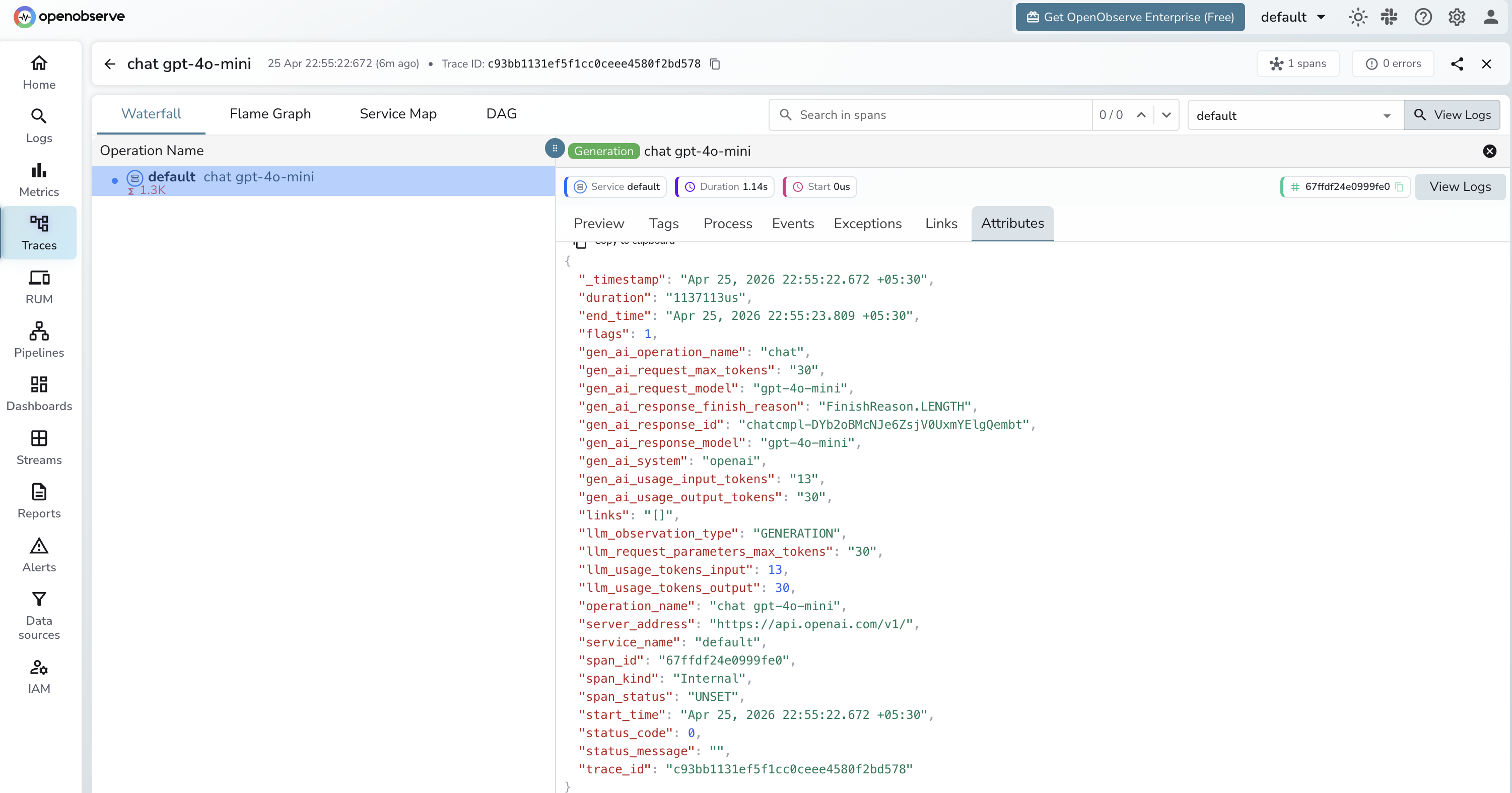
Viewing Traces
- Log in to OpenObserve and navigate to Traces
- Filter by span name
trubrics.llm_with_feedbackto see all tracked generations - Use the
trace_idin Trubrics to cross-reference with the OTel trace in OpenObserve
Next Steps
With Trubrics and OpenObserve both instrumented, user feedback is correlated with detailed trace data. Use Trubrics dashboards to track satisfaction scores and OpenObserve to diagnose the specific requests users flagged negatively.
Read More
Last updated on